
Article Written by VIKKAS RANA
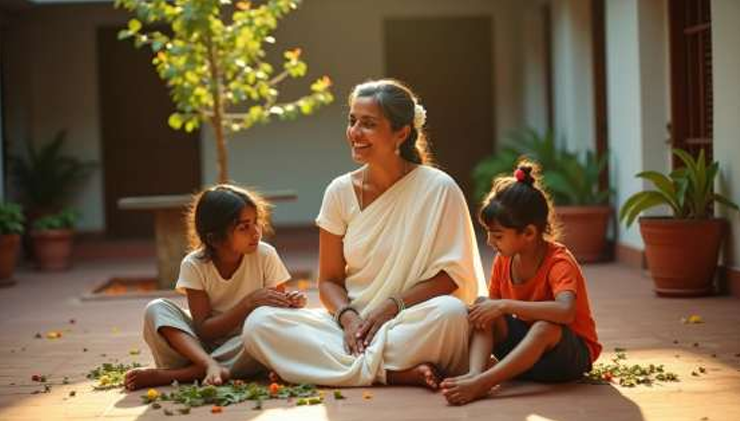
The mother in Sanatan tradition stands as the living embodiment of divine feminine energy—the nurturing force that sustains all creation. (Mother and motherland are greater than heaven)—this wisdom from our ancient texts illuminates the profound position mothers hold in both our inner and outer worlds. To understand mothers’ true role requires looking beyond biological function to recognize them as the primary architects of human consciousness itself.
Within Indian households, mothers serve as walking universities of humanity—providing emotional anchoring, spiritual guidance, and cultivating lifelong values in their children. The Vedic scriptures honor this unique position, acknowledging that a mother’s influence extends far beyond family boundaries. The values she instills shape her children’s character development, fostering citizens who naturally embody kindness, respect, and purposeful engagement with life.
Research confirms what spiritual wisdom has long recognized—children raised in nurturing family environments demonstrate stronger academic performance, greater emotional resilience, and increased financial stability as adults. Communities with strong family structures led by nurturing mothers show measurable improvements in social indicators: less poverty, lower crime rates, and more educated populations. When mothers step into entrepreneurship or advocate for social change, we witness Dharma manifesting in practical, transformative action.
The true power of motherhood lies in its capacity to dissolve differences and cultivate oneness. Through their unwavering presence and unconditional love, mothers function as society’s moral compass, teaching foundational values of empathy, patience, and kindness. In essence, they prepare the ground for us to evolve beyond limited perspectives of “me, mine, I” and embrace the truth of our shared divine origin that Sanatan wisdom has preserved through countless generations.
The Spiritual Foundation of Motherhood
“With the name of Mother comes the idea of Shakti, Divine Energy and Omnipotence, just as the baby believes its mother to be all-powerful, able to do anything.” — Swami Vivekananda, Influential Hindu monk and philosopher who introduced Vedanta to the Western world
Within the eternal wisdom of Sanatan Dharma, motherhood transcends biological function to become a profound spiritual force. Unlike other spiritual traditions, Sanatan culture uniquely perceives the maternal principle as the very foundation upon which existence itself rests.
Mother as the embodiment of oneness
The divine mother in Sanatan tradition represents the ultimate unifying principle. She is Aditi, the unborn Parā Shakti, simultaneously the creator and the creation itself. Through her expression of unconditional love, a mother naturally dissolves the boundaries between beings. As the Mahashakti, she “fills and supports worlds with the divine spirit and the all-sustaining force and delight without which they could not exist”. This universal presence makes her the living manifestation of oneness—the sacred truth that binds all creation together as one family.
Sanatan view of soul and divine motherhood
The Vedic scriptures teach that a soul’s journey through existence is fundamentally nurtured by maternal energy. Mothers create lasting impressions on a child’s consciousness, even before birth, establishing the foundation for spiritual growth regardless of circumstances. The story of Prahlada in the Bhagavat Purana powerfully illustrates this—while still in his mother’s womb, he absorbed spiritual teachings that transformed his consciousness, allowing him to become an exemplary devotee despite growing up under negative influences.
Why the mother is revered above all in Vedas
The Vedas elevate mothers to an unprecedented position of reverence. As stated in the Manu Smriti, “a teacher is tenfold superior to a lecturer, a father a hundredfold to a teacher, and a mother a thousand fold to a father”. This extraordinary status stems from the mother’s unique capacity for sacrifice and protection. The Mahabharata teaches that when Yudhishtir was asked what is heavier than Earth, he answered: “a person’s mother”—revealing that maternal importance exceeds even that of our planet.
Moreover, while the Vedas permit abandoning an immoral father, they firmly declare that a mother must always be protected and worshiped regardless of her character. This distinct reverence manifests practically—during Gaya Shradham ceremonies, fathers receive one pindam (offering), whereas mothers receive sixteen, acknowledging her multifaceted sacrifices.
From Womb to World: The Mother’s Role in Shaping Society
The womb stands as the first classroom in a child’s spiritual journey across Sanatan tradition. Before formal education begins, the mother initiates the soul’s societal conditioning through an invisible yet profoundly powerful connection that shapes consciousness itself.
Transmission of values before birth
The ancient stories within our Puranas reveal how consciousness develops within the sacred space of the womb. Abhimanyu learned the complex battle formation of Chakravyuha while listening to Krishna’s teachings from within Subhadra’s womb. When Lord Vishnu directed sage Narada to enter a peasant woman’s womb, even this enlightened sage temporarily forgot his divine knowledge—demonstrating the profound impact of prenatal experience on our deepest awareness. These accounts from vedic scriptures show that the maternal bond transmits not merely genetic material but spiritual inheritance that shapes lifelong tendencies.
The mother as the first environment
A mother’s body constitutes the child’s first physical universe—a living temple where consciousness begins to form its earliest impressions. Throughout Sanatan traditions, pregnant women immerse themselves in spiritual texts and devotional music for this very reason. Garbh sanskar (womb education) practices involve mothers reciting mantras, reading the Bhagavad Geeta, and maintaining inner peace. Like Devaki carrying Krishna, or Aditi nurturing the Adityas within her sacred space, a mother’s thoughts, emotions, and daily practices create the atmospheric foundation from which the emerging soul draws its first understanding of existence.
How early nurturing impacts collective consciousness
Children carry their earliest maternal impressions into wider society as they mature, gradually shaping our collective values through countless interactions. The respect for nature that Vedas teach begins with how a mother nurtures appreciation for all living beings. A mother practicing Dharma in her daily actions cultivates these same qualities in her children, who then become living carriers of these values throughout the social fabric.
Yashodha’s nurturing of Krishna, though not his biological mother, powerfully illustrates how maternal guidance transcends blood relations. Her simple yet profound teachings helped shape the consciousness that would later deliver the wisdom of the Bhagavad Geeta to humanity. The maternal principle thus creates an essential bridge between individual development and societal evolution. Mothers become the true architects of our collective consciousness—guardians of the oneness that Sanatan wisdom has always celebrated as our deepest truth.
Mothers as Catalysts for Social Evolution
“We have seen in Shri Ramakrishna how he had this idea of divine motherhood in every woman, of whatever caste she might be, or whatever might be her worth.” — Swami Vivekananda, Influential Hindu monk and philosopher who introduced Vedanta to the Western world
Throughout history, the quiet wisdom of mothers has sparked profound social transformation within Sanatan traditions. As living embodiments of Shakti – the divine feminine energy – mothers naturally extend their nurturing force beyond family boundaries to reshape entire communities.
Mothers leading change in education and health
Research confirms that, especially for daughters, across Africa, Asia, the Pacific, and Europe. This maternal influence has grown to match or exceed paternal impact in many regions. Children of educated mothers demonstrate better cognitive skills, giving them a significant advantage from their earliest years. A mother’s knowledge naturally extends to health consciousness, ensuring children receive proper nutrition, healthcare, and timely vaccinations. a mother’s educational status increasingly impacts her children’s educational mobility
The impact of these educated mothers extends far beyond individual families. When mothers understand both health and education, entire communities begin to transform. This isn’t merely social science—it reflects the ancient understanding that when the feminine principle is honored and educated, society naturally heals and evolves.
Balancing tradition and progress
The Sanatan way offers mothers unique wisdom for navigating between ancestral values and modern needs. Rather than abandoning tradition, mindful mothers thoughtfully select which customs align with core values and which require gentle reinterpretation. Cultural traditions connect children to their heritage—celebrating festivals, learning classical arts, absorbing stories from Puranas, and participating in meaningful rituals.
Mothers serve as living bridges between timeless Dharmic principles and our evolving social landscape. They intuitively recognize which elements of tradition nurture the soul and which practices might need adaptation. This discernment isn’t intellectual—it flows from the same wisdom that allows them to know when a child needs comfort versus challenge.
Raising children beyond caste, creed, and religion
Vice President Shri M. Venkaiah Naidu emphasized that, mothers possess a unique capacity to implement this vision through early education. They must first teach discernment rather than caste-blindness, helping children recognize and thoughtfully engage with social realities. children must “rise above the caste, creed, religious and other divisive differences and imbibe the virtues of ‘Sharing and Caring'”
Sanatan mothers naturally embody this inclusive approach because they are revered as “the nurturers and protectors of family and society”. They impart not just biological life but spiritual understanding. The Vedic scriptures recognize mothers as “the first teachers” who transmit values that transcend artificial social divisions.
A mother’s love doesn’t see caste or creed—it sees the divine spark in her child. As she extends this vision to all children, she teaches the most profound lesson of Sanatan Dharma: that beneath our differences, we share one divine consciousness. This lesson, learned in the sanctuary of maternal love, becomes the foundation for a society that honors unity within diversity.
Reclaiming the Sanatan Way in Today’s World
The ancient wisdom of Sanatan Dharma offers a practical pathway forward in our increasingly disconnected modern world. Rather than abstract philosophy, these timeless principles provide tangible guidance for healing the divisions that fragment contemporary society.
Practicing oneness in family and society
Vasudhaiva Kutumbakam—the world is one family—begins not as a lofty ideal but as lived experience within the home, with mothers serving as its first teachers. In Sanatan households, mothers naturally demonstrate how differences strengthen rather than divide us. Through family discussions that honor diverse viewpoints, children learn to embrace rather than fear difference. This foundation naturally extends into community life as children mature. When mothers engage in seva (service) alongside their children, they silently teach how individual actions contribute to collective well-being.
Encouraging spiritual growth in children
Mothers who follow Sanatan traditions nurture spiritual development through simple daily practices that create profound shifts in consciousness:
1. Sacred Morning Rituals Morning prayers connect children to universal consciousness, establishing a foundation of inner peace before the day begins
2. Stories as Teachers Sharing tales from the Puranas illustrates ethical principles through memorable narratives rather than abstract rules
3. Nature as Guru Simple walks in natural settings reveal divinity in creation, teaching reverence for all life forms
4. Inner Awareness Practices Age-appropriate meditation techniques help children recognize and cultivate their inner light
These practices ground children in wisdom that transcends materialistic values. Mothers who embody what they teach—demonstrating kindness, patience, and compassion in daily interactions—provide living examples that words alone cannot convey.
Breaking societal divisions through maternal wisdom
Maternal wisdom naturally dissolves artificial boundaries. A mother practicing Dharma sees beyond superficial divisions of caste or creed, recognizing the divine spark in all beings. This perspective, once transmitted to children, creates the foundation for healing societal fractures. Mothers hold unique power to dismantle prejudice before it takes root in young minds, replacing separation with recognition of fundamental oneness.
Living the truth of unity and divine connection
The Bhagavad Geeta teaches that enlightened beings see the same divine presence in all creatures. Mothers embody this teaching through unconditional love that mirrors cosmic oneness. Children first experience boundless acceptance through maternal love, receiving their initial glimpse of divine connection through this profound relationship. This lived experience of unity—not merely understood intellectually but felt deeply—becomes the foundation upon which children build their understanding of existence.
Reclaiming these Sanatan principles offers healing for our divided world by reminding us of our essential interconnectedness—a truth mothers have quietly preserved throughout countless generations.
My Message
The mother stands as the living embodiment of Sanatan’s most profound truth—that we are all connected through divine consciousness. Maternal love transcends biological ties, mirroring the cosmic principle of oneness that underlies all existence. Through their daily actions and teachings, mothers serve as humanity’s spiritual anchors, transforming abstract principles of Dharma into tangible practices that shape both individual souls and our collective consciousness.
When we honor mothers as the true architects of society, we recognize their extraordinary capacity to dissolve artificial boundaries through unconditional love. Their natural ability to see beyond caste, creed, and religious divisions provides a powerful blueprint for healing our fractured world. Throughout history, maternal wisdom has preserved the understanding that we are not separate beings but light-souls originating from a single divine source.
The ancient Sanatan way offers practical guidance for our modern challenges. Mothers who embody these timeless principles raise children who naturally question divisive thinking and recognize the divine spark in all beings. This recognition must extend beyond theory into lived experience. Households that practice oneness become living temples where spiritual growth flourishes naturally.
Reclaiming these maternal principles means elevating consciousness itself. Mothers guide us away from limited perspectives of “me, mine, I” toward the expansive truth of our shared divine heritage. This elevation of awareness restores Earth’s sacred nature, transforming it into the paradise it was always meant to be.
The journey toward oneness begins with honoring the maternal wisdom that Sanatan tradition has preserved through millennia. This wisdom remains our most powerful inheritance—not as abstract philosophy but as lived experience first encountered through the profound connection between mother and child. This connection, replicated across society, creates the foundation for a world united beyond all differences, finally embracing the truth of our shared divine origin.
References
https://satyameva.in/the-powers-of-the-mother
https://www.savetemples.org/post/mother-as-an-embodiment-of-sacrifice-and-protection/469
http://thoughtsonsanathanadharma.blogspot.com/2012/01/motherhood-in-sanatana-dharma.html
https://amitadevnani.com/blog-details/modern-parenting-in-india:-balancing-tradition-and-progressive-valueshttps://pib.gov.in/newsite/PrintRelease.aspx?relid=194457
https://nishantverma.in/role-of-women-in-sanatana-dharma-reverence-for-the-divine-feminine/