
World Turtle Day 2025: Honoring Earth’s Ancient Guardians
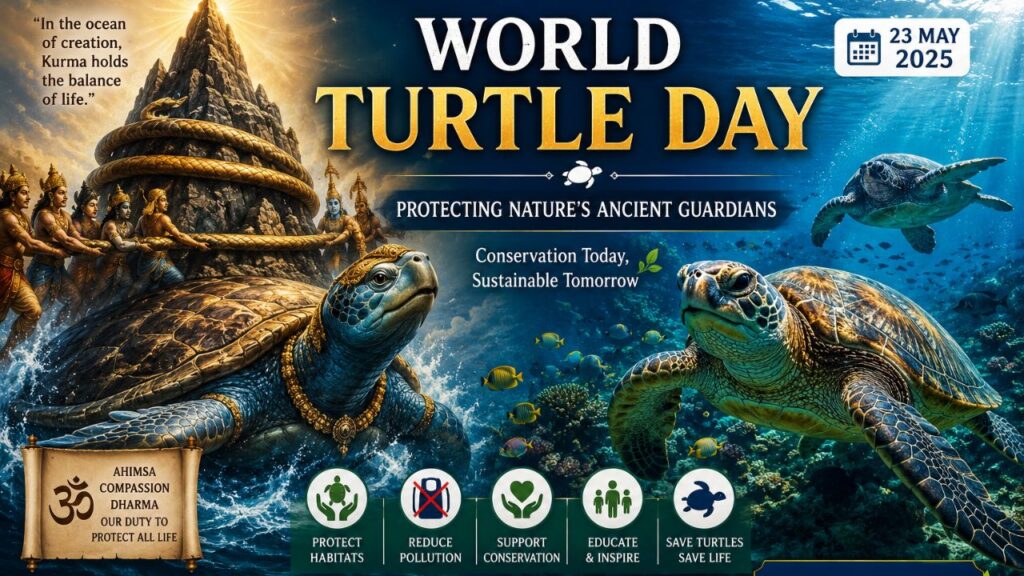
Every year on 23 May, people across the globe come together to celebrate World Turtle Day, a worldwide initiative dedicated to protecting one of Earth’s oldest surviving species—turtles and tortoises.
Having lived on our planet for more than 220 million years, turtles have survived the extinction of dinosaurs, dramatic climate changes, and countless geological transformations. Yet today, these extraordinary reptiles face one of their greatest threats—not from nature, but from human activity.
World Turtle Day reminds us that protecting turtles means protecting oceans, rivers, wetlands, forests, and ultimately the delicate ecological balance that sustains life on Earth.
As we observe World Turtle Day 2025, it is an opportunity not only to celebrate these remarkable creatures but also to reflect upon our collective responsibility toward nature. Interestingly, the values promoted by modern wildlife conservation closely align with the timeless teachings of Sanatan Dharma, where turtles have been revered for thousands of years as sacred symbols of stability, patience, wisdom, and cosmic balance.
The History of World Turtle Day
World Turtle Day was established in 2000 by the American Tortoise Rescue (ATR), a nonprofit organization founded by Susan Tellem and Marshall Thompson.
The primary objective was simple yet powerful:
To create global awareness about the declining populations of turtles and tortoises while inspiring people to actively participate in their protection.
Since its inception, World Turtle Day has grown into an international conservation movement celebrated in schools, universities, aquariums, wildlife organizations, and communities around the world.
People observe the day by:
- Organizing educational workshops
- Conducting beach and river clean-up drives
- Rescuing turtles crossing roads
- Supporting wildlife rehabilitation centers
- Promoting sustainable fishing practices
- Creating awareness through social media campaigns
- Adopting rescued turtles through authorized organizations
- Participating in scientific research and citizen science programs
The message remains universal:
Every turtle matters. Every habitat matters. Every action counts.
Why Turtles Matter to Our Planet
Turtles are often called the guardians of aquatic ecosystems because they play an essential role in maintaining ecological balance.
Maintaining Healthy Oceans
Sea turtles help regulate seagrass beds by grazing regularly. Healthy seagrass ecosystems provide breeding grounds for numerous marine species while also storing significant amounts of carbon.
Protecting Coral Reefs
Some turtle species feed on sponges that compete with coral reefs for space. By naturally controlling sponge populations, turtles indirectly support reef biodiversity.
Supporting Nutrient Cycling
Eggs that do not hatch provide valuable nutrients to coastal vegetation, strengthening dune ecosystems that protect shorelines from erosion.
Balancing Food Chains
Freshwater turtles and tortoises consume insects, aquatic plants, algae, carrion, and small animals, helping maintain healthy freshwater ecosystems.
The disappearance of turtles would create ripple effects across entire ecosystems.
The Current State of Turtle Conservation
Despite surviving for millions of years, turtles now face unprecedented challenges.
According to the IUCN Red List, six of the world’s seven sea turtle species are classified as Vulnerable, Endangered, or Critically Endangered.
The primary threats include:
| Threat | Impact |
|---|---|
| Habitat Loss | Destruction of nesting beaches and wetlands |
| Plastic Pollution | Ingestion of plastic bags, fishing lines, and microplastics |
| Climate Change | Rising sea levels, hotter nesting beaches, and altered hatchling sex ratios |
| Illegal Wildlife Trade | Hunting for shells, meat, eggs, and traditional products |
| Fishing Bycatch | Accidental capture in fishing nets leading to injury or drowning |
| Coastal Development | Loss of natural nesting habitats due to tourism and urbanization |
| Artificial Lighting | Disorients hatchlings, preventing them from reaching the ocean |
Human activities remain the largest driver behind turtle population decline.
Conservation Success Stories That Inspire Hope
Although the challenges are serious, conservation efforts have demonstrated that positive change is possible.
Green Turtle Recovery in Hawaii
After decades of conservation initiatives, the Hawaiian Green Turtle population experienced remarkable recovery, leading to an improved conservation status.
This achievement demonstrates that long-term protection strategies can restore wildlife populations.
Turtle Excluder Devices (TEDs)
Modern fisheries now increasingly use Turtle Excluder Devices, allowing turtles accidentally caught in fishing nets to escape safely.
These innovations have significantly reduced turtle mortality.
Protected Marine Areas
Many countries have established Marine Protected Areas (MPAs) where turtles can safely nest, feed, and migrate without excessive human interference.
Community-Based Conservation
Organizations such as WWF and SEE Turtles work directly with coastal communities, empowering local residents to become turtle guardians while generating sustainable livelihoods through eco-tourism.
Conservation succeeds best when local communities become partners rather than spectators.
Turtles in Sanatan Dharma: A Sacred Relationship with Nature
Long before modern conservation science emerged, Sanatan Dharma emphasized respect for every living being.
Among the many animals honored in Hindu philosophy, the turtle occupies a uniquely sacred position.
Lord Vishnu’s Kurma Avatar
One of the most celebrated stories appears in the Samudra Manthan (Churning of the Ocean).
When the Devas and Asuras churned the cosmic ocean to obtain Amrit (the nectar of immortality), Mount Mandara began sinking.
To support the mountain, Lord Vishnu manifested as Kurma, the giant cosmic turtle.
Kurma became the foundation upon which one of creation’s greatest events unfolded.
This symbolism teaches profound lessons:
- Stability during uncertainty
- Strength beneath great responsibility
- Patience in difficult times
- Balance between opposing forces
- Support for the creation and preservation of life
The turtle therefore represents much more than an animal—it symbolizes the very foundation of cosmic order.
Ahimsa and Compassion for All Living Beings
A central teaching of Sanatan Dharma is Ahimsa, the principle of non-violence toward every living being.
This philosophy encourages humanity to:
- Protect wildlife
- Preserve forests
- Respect rivers
- Avoid unnecessary harm to animals
- Live in harmony with nature
Protecting turtles naturally becomes an expression of Ahimsa.
Dharma and Environmental Responsibility
In Sanatan philosophy, Dharma extends beyond personal morality.
It also includes our responsibility toward:
- Nature
- Water
- Forests
- Wildlife
- Future generations
Protecting endangered species becomes part of fulfilling one’s Dharma by preserving the ecological balance upon which all life depends.
Ancient Wisdom Meets Modern Conservation
Modern environmental science increasingly emphasizes ideas that resonate with Sanatan philosophy.
Both perspectives recognize that:
- Every species has ecological value.
- Human well-being depends on healthy ecosystems.
- Nature should be protected rather than exploited.
- Long-term sustainability requires responsible stewardship.
By integrating cultural values with scientific conservation, communities can build stronger and more enduring commitments to protecting biodiversity.
How You Can Help Protect Turtles
Every individual can make a meaningful difference.
Reduce Plastic Waste
Avoid single-use plastics that often end up in oceans and rivers where turtles mistake them for food.
Participate in Beach Cleanups
Removing litter from beaches protects nesting sites and prevents marine pollution.
Support Ethical Conservation Organizations
Contribute to organizations working directly in turtle conservation through research, habitat restoration, and rescue efforts.
Never Purchase Turtle Products
Avoid buying products made from turtle shells, eggs, or meat.
Demand drives illegal wildlife trade.
Practice Responsible Tourism
If visiting turtle nesting beaches:
- Maintain a safe distance
- Avoid flash photography
- Follow local conservation guidelines
- Never disturb nesting females or hatchlings
Educate Others
Share knowledge about turtle conservation through schools, families, and social media.
Awareness is often the first step toward action.
Lessons Turtles Teach Humanity
Beyond ecology and mythology, turtles offer timeless life lessons.
They remind us to:
- Move with patience rather than haste.
- Build resilience through consistency.
- Remain grounded during life’s storms.
- Protect what sustains future generations.
- Live in harmony with nature instead of dominating it.
Their survival over millions of years is a testament to endurance, adaptability, and balance.
Conclusion
World Turtle Day is far more than an environmental observance—it is a reminder of humanity’s shared responsibility toward the natural world.
Modern conservation science provides practical solutions for protecting turtles, while the timeless wisdom of Sanatan Dharma offers a moral and spiritual foundation for respecting all forms of life.
Together, these perspectives create a powerful vision for the future—one where ancient values and modern knowledge work hand in hand to preserve Earth’s biodiversity.
As we celebrate World Turtle Day 2025, let us honor these remarkable creatures not only with words but with meaningful action.
Every protected beach, every rescued turtle, every reduced piece of plastic, and every informed individual contributes to a healthier planet.
Protecting turtles ultimately means protecting the oceans, protecting biodiversity, and protecting our own future.
Frequently Asked Questions (FAQs)
Why is World Turtle Day celebrated?
World Turtle Day is observed every year on 23 May to raise awareness about turtle and tortoise conservation and encourage actions that protect their habitats.
Why are turtles important to ecosystems?
Turtles help maintain healthy seagrass beds, coral reefs, freshwater ecosystems, and nutrient cycles, making them vital to ecological balance.
What does the Kurma Avatar symbolize?
The Kurma Avatar of Lord Vishnu symbolizes stability, patience, strength, and the support of cosmic balance during the Samudra Manthan.
How can I help turtle conservation?
You can reduce plastic waste, support wildlife organizations, participate in beach cleanups, avoid purchasing turtle products, and spread awareness about conservation.